N1 Acoustic Specialists
Secondary Glazing Islington: Noise Reduction Windows for N1 Terraces
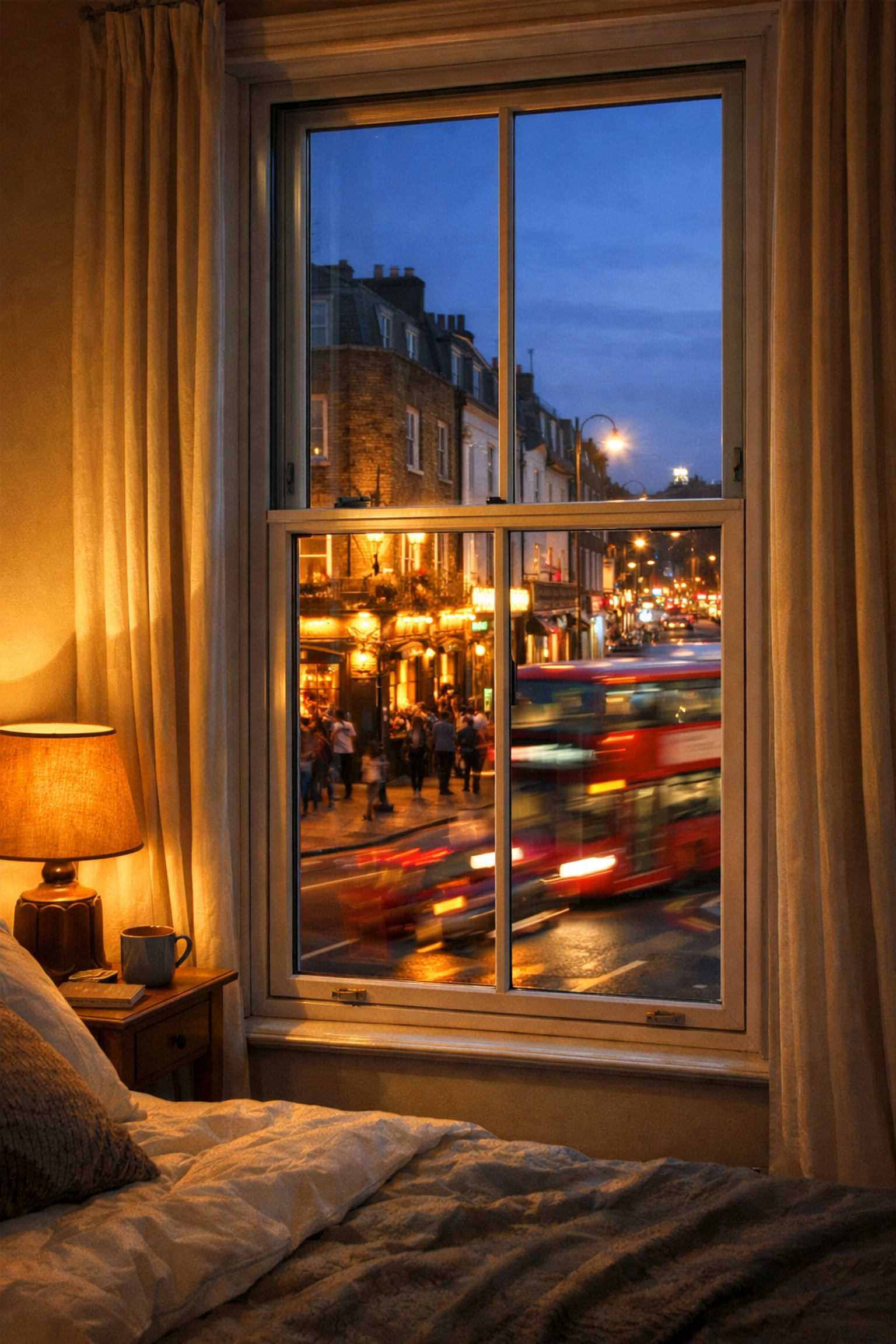
If you own a Georgian or Victorian terrace in Islington, you already know the drill. Beautiful original windows, gorgeous proportions, and absolutely freezing in winter. Plus, if you're anywhere near Upper Street, City Road, or any of N1's main arteries, the noise never really stops.
Islington has the highest rate of vehicle-related noise complaints in London — 13 per 10,000 residents. Our secondary glazing sash windows deliver up to 54dB reduction without compromising your period features or requiring planning consent.
London's Worst for Vehicle Noise: 13 Complaints per 10,000 Residents
Islington isn't just "a bit lively" — it's regularly flagged as one of London's noisiest places to live. The borough records the highest rate of vehicle-related noise complaints in London at 13 per 10,000 residents — the kind of stat that makes total sense if you've ever tried to sleep with your window cracked open in N1.
Islington has also been described as the 4th worst borough in London for noise nuisance overall. The noise isn't evenly spread — it clusters around familiar hotspots: Upper Street's nightlife corridor, City Road's industrial hum, and the constant stop-start traffic at Highbury Corner.
Your windows are probably the main culprit. But replacing them? That's a planning permission nightmare in most of Islington's 50+ conservation areas. Secondary glazing sash windows are the approved solution — keeping period features intact while actually making your home comfortable.
Stop-Start Traffic
N1's narrow streets amplify acceleration, revving, and braking noise. 10.8mm acoustic laminate handles the sharp, impulsive peaks that lighter glass transmits.
Upper Street Nightlife
Bars, restaurants, and late-night venues create persistent evening noise at 70–80dB. Our compression-sealed glazing blocks both mid-frequency chatter and music bass.
City Road Industrial Hum
Data centres, commercial plant, and extract fans along City Road create persistent low-frequency drone. Our 10.8mm glass + 100mm+ air gap is engineered to block it.
Heritage Approved
Islington Council's conservation policies are strict. Our secondary glazing installers deliver systems that are fully reversible and approved across all N1 conservation zones.
Local Noise Profile
Every street in N1 has a different noise character. Here are the key problem zones we've surveyed and treated:
Upper Street / A1 Corridor
Heavy bus and commercial traffic from 6am to midnight plus London's densest concentration of nightlife venues generating 70–80dB. Routes 4, 19, 30, 43, and 73 create sustained diesel rumble. Late-night taxis, delivery vans, and the constant hum of bar and restaurant extract fans compound the problem.
For Upper Street-facing properties, 10.8mm acoustic laminate is essential — you need glass that handles both the sharp nightlife peaks and the sustained low-frequency bus rumble.
Affected postcodes: N1 0PD, N1 1QP, N1 2XG
City Road: The Industrial Hum
City Road carries a constant "urban hum" — but in some stretches, the low-frequency rumble feels extra noticeable. Data centres, commercial HVAC plant, kitchen extract fans, and dense mixed-use buildings create what residents often describe as an "industrial" background noise that's harder to mask than normal traffic.
This persistent tonal drone requires the same approach as commercial plant noise: mass (10.8mm glass) + air gap (100mm+) for effective low-frequency attenuation.
Affected postcodes: N1 9FN, EC1V 1JN, EC1V 2NX
Highbury Corner & Holloway Road
Busy junction energy, stop-start traffic, and plenty of revving when the lights change. The A1 continuation north carries 35,000+ vehicles daily with sustained 74–82dB. The Arsenal / Emirates Stadium adds match-day crowd spikes.
Affected postcodes: N7 8HG, N7 6PA, N5 1RA
Essex Road / New North Road
Bus-heavy corridor with stop-start traffic at multiple junctions creating persistent acceleration and braking noise affecting Canonbury terraces. Combined with Overground rail noise from the east.
Affected postcodes: N1 8LZ, N1 3PB, N1 2BL
The N1 Stop-Start Problem: Why 10.8mm Is the Only Real Fix
Islington's noise profile is different from most London boroughs. It's not just "traffic" — it's stop-start acceleration, revving at night, delivery vans, and the occasional impatient horn. On N1's narrow terraced streets, sound bounces between facades and finds its way through every tiny gap in old sashes.
This creates a noise character with two distinct challenges:
Sharp Impulse Peaks
Revving, braking, horns, sirens — sudden onset, high-energy sound events that single glazing transmits almost unattenuated. Standard 6.4mm glass struggles with these peaks.
Constant Low-Frequency Wash
Bus engines, heavy traffic, commercial plant drone — the sustained "hum" that wears you down. This sub-200Hz energy requires mass to block and an air gap to decouple.
10.8mm Stadip Silence acoustic laminate is the sweet spot for Islington. Its asymmetric construction (6.4mm + acoustic PVB + 4.4mm) provides the mass to tackle both the sharp irritating peaks and the constant wash of traffic. Combined with a 100–150mm air gap, it achieves 48–54dB reduction — the difference between lying awake counting double-deckers and actually getting a decent night's sleep.
10.8mm
Acoustic laminate — handles both impulse peaks and sustained rumble
54dB
Maximum reduction with optimal air gap — measured in N1 installations
80%
Perceived noise reduction — Upper Street at 2am becomes background whisper
Not sure which spec you need? Use our Acoustic Calculator to model the expected reduction for your specific window type, air gap, and noise source.
Glass Performance: Sound Reduction vs. Thickness
For N1 properties near Upper Street, City Road, or the A1 corridor, we recommend 10.8mm acoustic laminate as the benchmark. Here's how the options compare:
| Glass Type | Thickness | Sound Reduction | Best For |
|---|---|---|---|
| Standard Laminate | 6.4mm | 35–40dB | Quiet mews, canal-side windows |
| Enhanced Laminate | 6.8mm | 38–44dB | Essex Road, secondary streets |
| Stadip Silence | 10.8mm | 48–54dB | Upper Street, City Road, A1 corridor |
Energy Bills & Draughty Terraces
Here's another reality of period terraces: they're gorgeous, but they leak heat. Those single-glazed windows, the gaps around the frames, the lack of modern insulation — it all adds up to sky-high heating bills.
Noise reduction windows with secondary glazing cut heat loss through your windows by around 60%. For anyone living in a typical Islington terrace with three or four storeys, that saving adds up fast. You're not just making your home more comfortable — you're reducing your carbon footprint and putting money back in your pocket every month.
Conservation Area Solutions
Islington contains over 50 conservation areas where window replacement is prohibited. Our secondary glazing installers deliver the only approved solution for noise and thermal improvement.
Canonbury Conservation Area
Georgian squares & early Victorian terraces
Challenge:
Large sash windows with delicate glazing bars and original crown glass
Our Solution:
Ultra-slim vertical slider secondary glazing with heritage colour-matching to original joinery
Barnsbury Conservation Area
Regency & early Victorian townhouses
Challenge:
Oversized drawing-room sashes and narrow reveals in basement conversions
Our Solution:
10.8mm Stadip Silence with bespoke frame setbacks to accommodate working shutters
Duncan Terrace / Colebrooke Row
Grade II listed Georgian terraces along the canal
Challenge:
Proximity to A1 traffic plus canal-reflected noise; irreplaceable original glass
Our Solution:
Decoupled secondary panels with 100mm+ air gap for maximum low-frequency attenuation
Conservation Area & Listed Building Notice
Secondary glazing is the preferred choice for Grade II listed properties and conservation areas in the London Borough of Islington. Because it is installed on the interior, is fully reversible, and makes no alteration to the external façade, it typically requires no planning permission — even in Canonbury, Barnsbury, and Highbury New Park.
Our slimline aluminium frames sit discreetly behind original secondary glazing sash windows in Islington's iconic Georgian terraces — invisible from the street and fully compliant with council conservation policies.
Read our Listed Buildings GuideSoundproofing Resources
Islington & Canonbury Guide
Street-by-street noise analysis for N1, N5, and N7 postcodes.
Soundproof Secondary Glazing
How noise reduction windows work — glass types, air gaps, and STC ratings.
Traffic Noise Solutions
How we tackle A1 corridor and Upper Street traffic with 10.8mm acoustic glass.
Pricing Guide
Transparent pricing for secondary glazing sash windows cost — from £350 to £1,400 per window.
Glass Specifications
Compare STC ratings and dB reduction for every glass type we specify.
Listed Buildings Guide
Conservation area compliance for Islington's protected Georgian terraces.
Sources & References
Government & Regulatory
- Historic England. "Traditional Windows: Their Care, Repair and Upgrading (HEAG039)". HistoricEngland.org.uk, 2017.Link
Provides essential guidance on the requirements for altering windows in listed buildings and conservation areas, supporting the use of secondary glazing as a reversible solution.
- Islington Council. "Islington Urban Design Guide: Planning Guidance (SPD)". Islington.gov.uk, 2017.Link
The statutory planning document for Islington which outlines the conservation requirements for maintaining historic window features in N1 and surrounding districts.
Scientific & Technical
- World Health Organization (WHO) Europe. "Environmental Noise Guidelines for the European Region". WHO Regional Office for Europe, 2018.Link
A comprehensive study detailing how secondary glazing with specific glass thicknesses, such as 10.8mm laminate, provides superior acoustic insulation compared to standard double glazing.
- C. Hopkins. "Sound Insulation in Buildings". Acoustic Performance of Windows and Glazing (Elsevier), 2012.
Explains the scientific principles of sound reduction using laminated glass and the 'air-gap' effect between the primary window and secondary unit.
Industry Standards
- British Standards Institution (BSI). "BS 8233:2014 Guidance on sound insulation and noise reduction for buildings". BSI Group, 2014.Link
The British Standard providing the code of practice for sound insulation and noise reduction in buildings, relevant to secondary glazing installations.
- The Glass and Glazing Federation (GGF). "The Benefits of Secondary Glazing". GGF Technical Manual, 2017.Link
Technical data on the thermal and acoustic benefits of secondary glazing systems specifically designed for heritage sash windows.
Citations generated with AI assistance. Please verify sources independently.